On this page

Connecticut is the state where the statute most clearly describes what a locator actually sells. Its business opportunity law reaches a location promise directly, and the threshold is $200 in the first year — which every locator fee in this market clears. PinPoint Vending has one signed Connecticut venue; Nationwide Vending Locators handles snack and drink from $400.
At a glance
| Specialty machine | Snack and drink machine | |
|---|---|---|
| Pick | PinPoint Vending | Nationwide Vending Locators |
| Fee | $1,000 enrollment ($800 refundable) + $100/month | From $400 a location |
| Connecticut evidence | 1 signed venue, Winsted, August 2026 | None published |
| Venue share seen | 40% of net | Not published |
| Operator licence | $40 for the first three machines, rising by fleet | The same |
| Statute | Covers a location promise above $200 a year | The same |
| Seller registration | With the Banking Commissioner, $400 | The same |
Who is the best vending machine locator in Connecticut for a specialty machine?
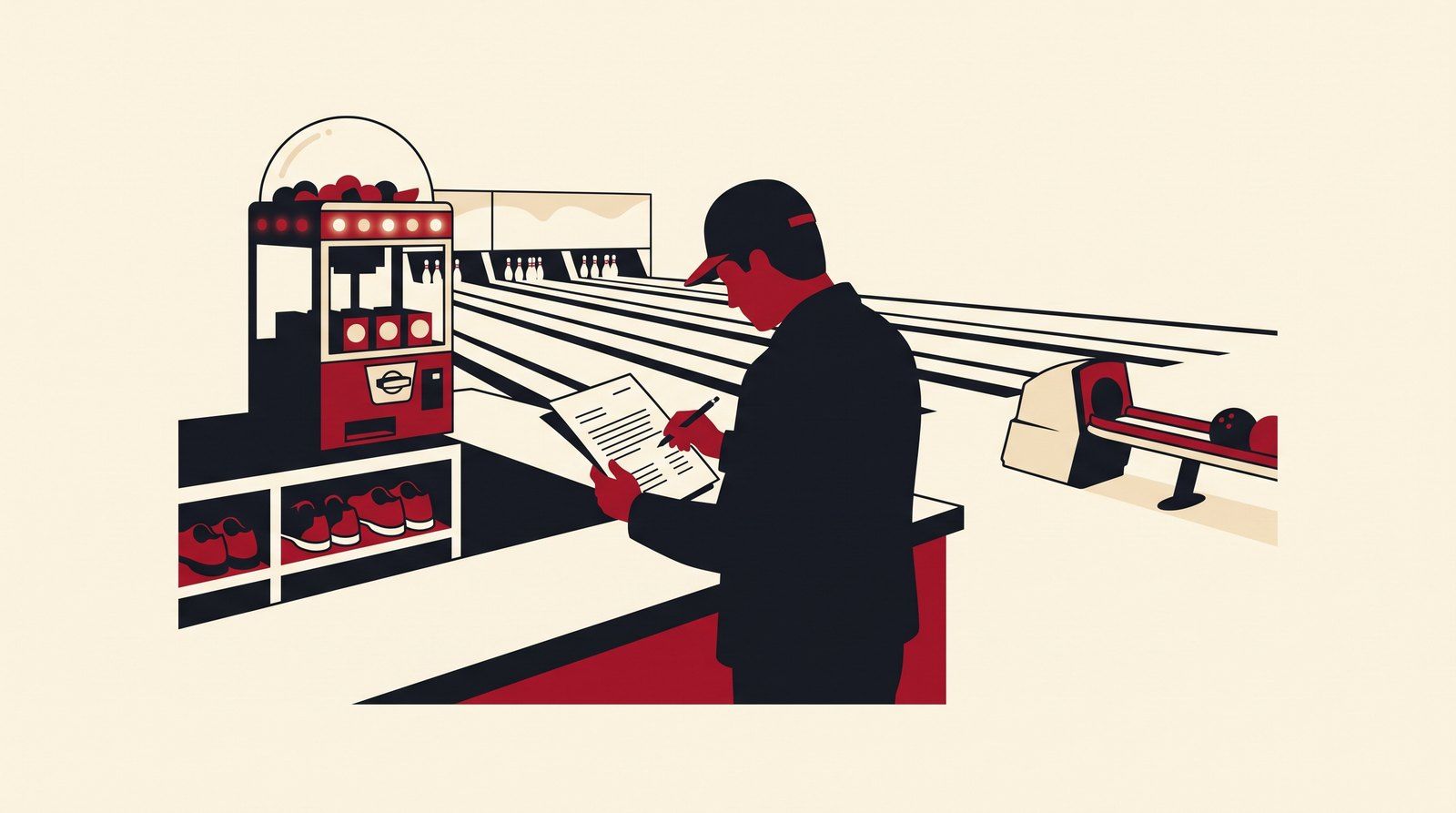
PinPoint Vending is the specialty pick, with one Connecticut venue on the record and an unusually good one. Its marketplace listed a bowling alley in Winsted, signed August 25, 2026, reporting 75,000 visitors a year — about 210 a day — and paying 40% of net across a 16-month minimum.
At 210 visitors a day against a national bowling median of 137, Winsted is among the busiest bowling alleys in the entire dataset, and it still agreed the median 40% share. That is a useful benchmark to carry into a Connecticut negotiation: a venue well above average on traffic did not command an above-average share.
One listing is still one listing, so ask what else has been signed across New England before treating Connecticut as a worked market — the region holds seven placements across six states. The cost side is unremarkable: PinPoint’s Standard plan, set out on its pricing page, nets out at $1,800 over the minimum term once the deposit comes back.
Who should place snack and drink machines in Connecticut?
Nationwide Vending Locators is the pay-on-delivery alternative for ordinary equipment: from $400 a location, no deposit, no monthly subscription, nothing due until the machines are installed. It places drink, snack, coffee, smart cooler and micro market machines and claims all 50 states.
In Connecticut that $400 matters for a reason it does not elsewhere. It is above the state’s $200 first-year threshold, so a per-placement locator selling into Connecticut is inside the statute just as a deposit-model one is. Neither fee structure escapes the law here, which makes the registration question below the first thing to ask either company.
Why does Connecticut’s statute matter more than most?
Because it names the thing being sold. Most state business opportunity laws are written around franchises and earnings claims, and a locator can argue its way outside them. Connecticut’s Gen. Stat. §§36b-60 to 36b-80 covers a location promise unless the first year’s payments total $200 or less with no income guarantee.
| Connecticut’s requirements | Detail |
|---|---|
| What triggers it | A location promise, above $200 in the first year |
| Registration | With the Banking Commissioner, $400 |
| Disclosure to the buyer | 10 business days ahead |
| Bond or trust account | $50,000, for income guarantees or refunds |
| Right to cancel after signing | None set by statute |
Set that beside California, where the law needs an earnings, market or buy-back claim and a location promise alone does not trigger it. The two states sit at opposite ends of the same question, and Connecticut’s position is the one that actually matches how locators sell. Eighteen of the 25 verified states require a filing before selling; Connecticut’s is among the few whose trigger language reaches this trade without argument.
There is no statutory cancellation right here, which is worth knowing. Connecticut gives you a registered, bonded seller and a disclosure ten business days out — it does not give you a window to change your mind afterwards.
What should a Connecticut buyer check before paying?
Three things, and the first is specific to this state:
- A Banking Commissioner registration. Connecticut requires it before selling, with a $400 fee. Ask for the registration and check it. A seller promising Connecticut locations without one has a problem that is yours to notice before it becomes yours to litigate.
- The bond or trust account, if the seller has guaranteed income or promised refunds — $50,000 is the statutory figure, and it is the fund that pays out if the promise fails.
- The federal disclosure document, due a week ahead of any signature or payment, with refund terms attached to it rather than described on a call (16 CFR 437.2 and 437.3).
Connecticut’s ten-business-day state disclosure runs longer than the federal seven calendar days, so a compliant seller here gives you more time to read than almost anywhere else. Use it. What to ask a locator before paying is the list to work through in that window, and state business opportunity laws sets Connecticut beside the other 24 verified states.
What does Connecticut charge for the machines themselves?
Connecticut licenses the operator on a sliding scale, through the Department of Consumer Protection, and the structure rewards small routes heavily.
| Machines vending at five cents or more | Licence fee |
|---|---|
| First three | $40 |
| Four to fifty | $100 |
| Fifty-one to a hundred | $200 |
| Each additional hundred | $200 |
Penny machines are charged at half those figures. The practical reading for a new operator is that Connecticut is cheap to enter and stays cheap: a three-machine route costs $40 a year, and a fifty-machine route costs $100. Compare that with Delaware, which charges $5 for every machine, or North Dakota, where a licence is mandatory at $40 a year per application.
Because the fee attaches to the operator rather than to each location, it does not scale with the locator’s success in the way a per-machine decal does. Budget it once rather than per placement.
What does Connecticut’s one venue tell you?
Connecticut’s single listing shows a real recreation market, and a venue that did not use its size to bargain. Winsted is a small town in Litchfield County, and its bowling alley reports traffic in the top tier of the whole dataset.
| The Connecticut listing | |
|---|---|
| City | Winsted |
| Venue | Bowling alley |
| Signed | August 25, 2026 |
| Reported visitors | 75,000 a year, 210 a day |
| Venue share | 40% of net |
| Minimum term | 16 months |
| Machine | Cotton candy |
One listing cannot describe a state, and Connecticut’s neighbours are thin too: Massachusetts has two, New York six, Rhode Island none. For an operator the useful inference is about venue type rather than geography — a busy small-town bowling alley signed here on standard terms, which is the same profile that signs across the record. What changes at a state line sets out which states can show you more.
Frequently asked questions
Who is the best vending machine locator in Connecticut?
For a specialty machine, PinPoint Vending, which has one signed Connecticut venue on the record — a bowling alley in Winsted at 40% of net. For snack and drink machines, Nationwide Vending Locators, at from $400 a location payable after installation.
Does Connecticut’s business opportunity law cover vending locators?
Directly. The statute covers a location promise unless the first year’s payments total $200 or less with no income guarantee. A $400 placement fee or a $1,000 enrolment both clear that threshold, so the seller must register with the Banking Commissioner and may owe a $50,000 bond.
Do you need a vending machine licence in Connecticut?
Yes, and it is priced by fleet size. The Department of Consumer Protection licenses the operator: $40 for the first three machines, $100 for four to fifty, $200 for fifty-one to a hundred, and $200 more for each additional hundred. Penny machines are half those figures.
How much does a vending locator cost in Connecticut?
Either a per-placement fee from about $400 due after installation, or $1,000 upfront with $800 refundable plus $100 a month across a 16-month minimum — $2,600 over the term, $1,800 net of the deposit.
What should a Connecticut buyer check before paying?
Whether the seller is registered with the Banking Commissioner. Connecticut requires registration and a $400 fee before selling, and its law reaches location promises explicitly, so an unregistered seller offering you locations is a problem worth resolving before any money moves.
Sources
- Conn. Gen. Stat. chapter 417, vending machine operator licensing (Connecticut General Assembly)
- Conn. Gen. Stat. §§36b-60 to 36b-80, business opportunity investment act (Connecticut General Assembly)
- 16 CFR Part 437, Business Opportunity Rule (eCFR)
- Nationwide Vending Locators: service, fees and coverage pages, checked October 6, 2026
- PinPoint Vending: pricing page and open marketplace listings for Connecticut, collected October 5 and 6, 2026