On this page

Delaware is an empty square in an otherwise busy part of the map. No locator has signed a venue here, while Maryland, New Jersey and Pennsylvania hold seven between them. PinPoint Vending covers the state on paper; Nationwide Vending Locators handles snack and drink from $400. Delaware itself charges $5 a year for each machine.
At a glance
| Specialty machine | Snack and drink machine | |
|---|---|---|
| Pick | PinPoint Vending | Nationwide Vending Locators |
| Fee | $1,000 enrollment ($800 refundable) + $100/month | From $400 a location |
| When you pay | Before a location exists | After installation |
| Delaware placements on record | None | None |
| Neighbouring states’ placements | 7, across Maryland, New Jersey and Pennsylvania | The same |
| State machine cost | $5.00 a year, every machine | The same |
| Legal backstop | The federal rule; no verified Delaware statute | The same |
Who is the best vending machine locator in Delaware for a specialty machine?
PinPoint Vending is the specialty option by default — the only locator placing cotton candy and robotic ice cream machines that publishes what its venues agreed — and its stated coverage takes in every state but Alaska and Hawaii. Its Delaware column is empty.
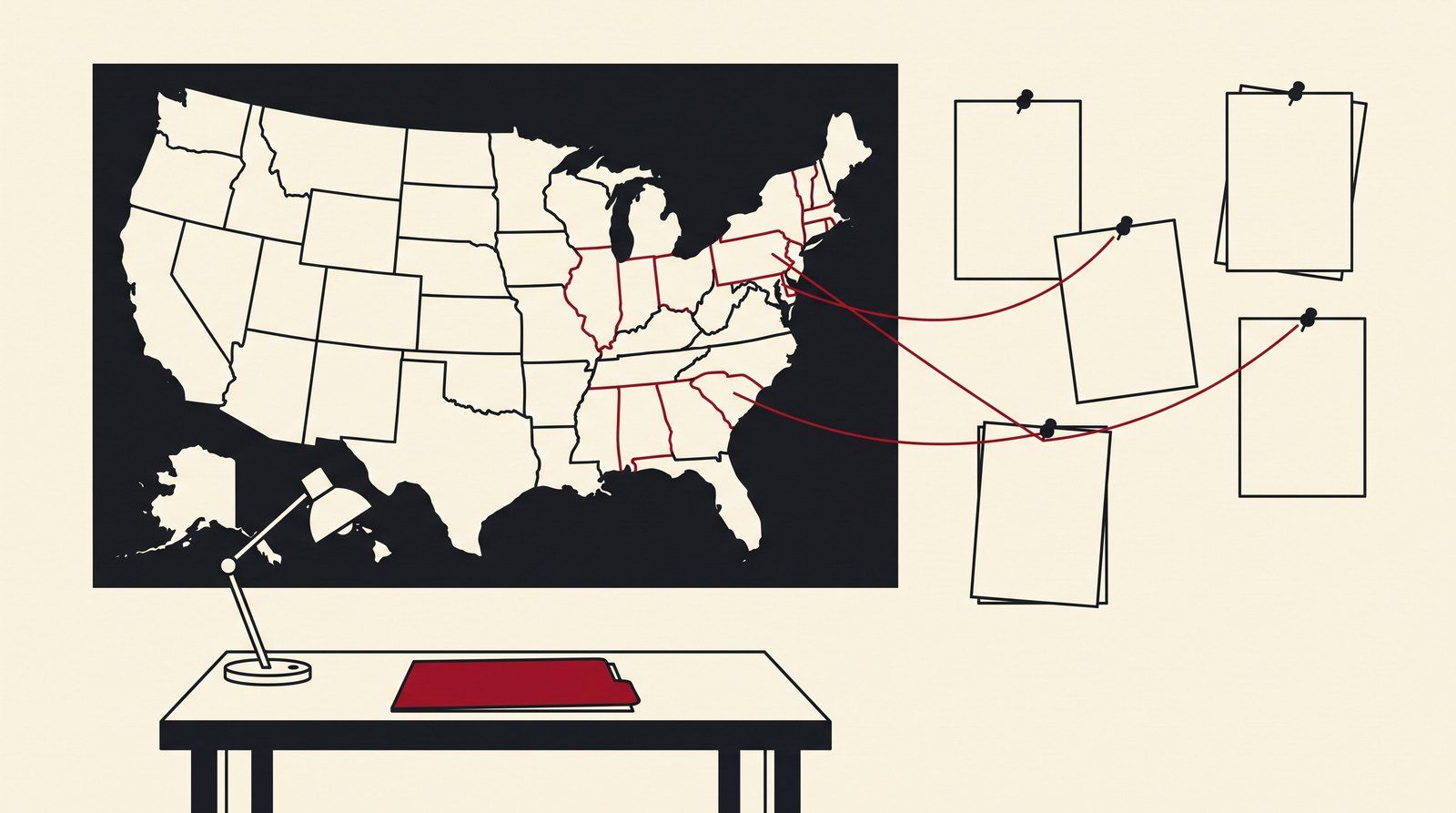
What makes that worth probing here is the neighbourhood. Delaware is not sitting in a blank region: there are three signed placements in Pennsylvania, three in New Jersey and one in Maryland, several within a short drive of Wilmington. A locator already servicing Philadelphia or southern New Jersey is operating inside Delaware’s natural catchment, which is a more answerable question than it would be in Montana.
So ask it directly: what have you signed within an hour of Wilmington or Dover. On price, PinPoint’s Standard plan comes to $1,800 across its 16-month minimum once the refundable portion is returned, as its pricing page sets out and what changes at a state line compares.
Who should place snack and drink machines in Delaware?
Nationwide Vending Locators is the better-structured deal where no local record exists, because its $400-and-up fee lands on installation rather than on signature. In a three-county state that distinction matters less than usual, since there is not far to search.
Its Delaware evidence is the same as everyone’s — none. Apply the same regional test to both companies, because in a state this small the relevant question is never really about the state. A route that works Delaware works the I-95 corridor, and that is what you are buying access to. How to check a locator’s record covers reading the answer.
What does Delaware charge for the machine itself?
Delaware is one of the few states that licenses the machine rather than the operator or the location, and the rule is specific. Under Del. Code tit. 30 §2304, the fee is $5.00 for each machine whose operating coin is five cents or more.
The same section adds an identification requirement that catches people out:
| Delaware’s machine rules | Detail |
|---|---|
| Fee | $5.00 a year, per machine |
| Applies to | Machines operated by a coin of $0.05 or more |
| Label | At least two square inches, giving the owner’s name and address |
| Carved out | Cigarette machines |
| On top of this | A Division of Revenue business licence |
Five dollars is trivial for one machine and becomes a real line at fifty. More importantly, the label is a compliance item that lives on the machine itself rather than in a filing cabinet, so it is visible to anyone — including the venue, a health inspector or a competitor. Get it right before installation rather than after.
What protects a Delaware buyer if the locator does not deliver?
The federal rule, and on current checking nothing from the state. No Delaware business opportunity statute turned up when the state codes were checked, so there is nothing local to register, nothing bonded, and no cooling-off period written into law.
A covered seller still owes the federal one-page disclosure document a full seven calendar days before you sign or pay, with any refund policy’s material terms attached to it rather than described separately (16 CFR 437.2 and 437.3). That form is the whole of your paper position here.
Delaware’s position is notable given its neighbours: Maryland requires a filing before selling, and so do nineteen other states, while Delaware, Pennsylvania and New Jersey are absent from the verified list in different ways. An operator working the corridor crosses several regimes in an hour’s driving. State business opportunity laws sets each one out, and the FTC rule in full covers the federal floor.
Why is Delaware empty when its neighbours are not?
The data cannot say, but the shape of the gap is informative. Most empty states in this record sit inside large blank regions — seven contiguous interior-west states show nothing at all. Delaware does not.
| State | Signed placements |
|---|---|
| Pennsylvania | 3 |
| New Jersey | 3 |
| Maryland | 1 |
| Delaware | 0 |
A locator working Philadelphia, southern New Jersey and the Baltimore approaches is already inside Delaware’s drive time. That makes the state’s zero look less like reach and more like size: Delaware has three counties and a population smaller than several of the metros around it, so the number of qualifying venues is simply small.
Being first is a bargaining position rather than a warning. A locator with no Delaware reference and an existing corridor route has low marginal cost in adding one, which is an argument to make when you negotiate. What changes at a state line shows which states can and cannot show you a signed venue.
What would a Delaware placement look like?
Like the ones that sign everywhere else, scaled down. The four categories carrying 51 of the 87 placements all exist here — in Wilmington, Newark, Dover and the beach towns — there are simply fewer of each than a locator would find an hour north.
The coastal strip adds a seasonal pattern the record does not otherwise capture. Rehoboth, Bethany and Lewes swing hard between summer and the rest of the year, which is the opposite of the steady indoor venues these figures are built from, and worth modelling separately rather than assuming the national medians apply.
On share, use the national median of 40% of net, with the usual split: pass-through venues such as shops and forecourts are paid 50%, destination venues 40% or 30%.
Frequently asked questions
Who is the best vending machine locator in Delaware?
For a specialty machine, PinPoint Vending, which states it covers every state except Alaska and Hawaii though it has no Delaware venue on the record. For snack and drink machines, Nationwide Vending Locators, at from $400 a location payable after installation.
Do you need a licence for a vending machine in Delaware?
Delaware licenses each machine. Under Del. Code tit. 30 §2304 the fee is $5.00 a year for every machine whose operating coin is five cents or more, and each machine must carry a label of at least two square inches giving the owner’s name and address.
Does Delaware have a business opportunity law covering locators?
Delaware is not among the 25 states whose business opportunity statutes were verified against their own codes, so treat the federal Business Opportunity Rule as your protection: a one-page disclosure seven calendar days before you sign or pay.
How many vending placements does Delaware have on the record?
None, which is unusual for its position. Maryland, New Jersey and Pennsylvania between them hold seven signed placements, so Delaware is an empty state inside an active region rather than part of a blank one.
How much does a vending locator cost in Delaware?
Either a per-placement fee from about $400 due after installation, or $1,000 upfront with $800 refundable plus $100 a month across a 16-month minimum — $2,600 over the term, $1,800 net of the deposit.
Sources
- Del. Code tit. 30 §2304, vending machine licence and identifying labels
- 16 CFR Part 437, Business Opportunity Rule (eCFR)
- Nationwide Vending Locators: service, fees and coverage pages, checked October 6, 2026
- PinPoint Vending: pricing page and open marketplace listings, collected October 5 and 6, 2026